In motion: The Earth’s ocean and atmospheric currents
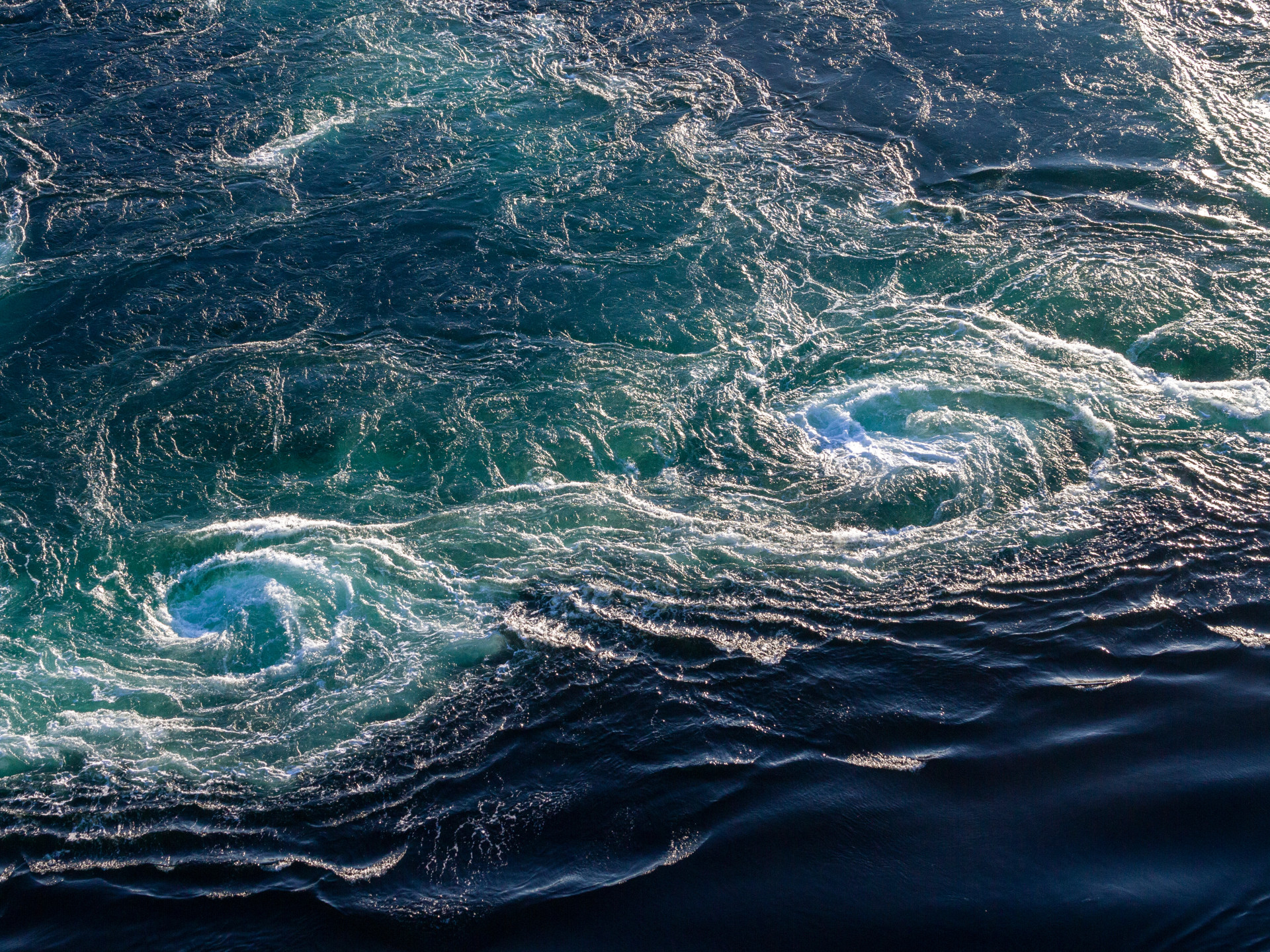
Currents in the oceans and atmosphere distribute heat throughout the Earth system. They are changing as global temperatures rise, with far-reaching effects on the climate in different regions of the world.
Water and air, the flowing components of the Earth system, transport energy and chemical substances - between regions of the planet and between different parts of the ocean and atmosphere. Over the course of Earth’s history, these flows have taken on different patterns.
For around ten thousand years, the prevailing patterns of heat distribution have provided relatively stable conditions for human life in many regions of the world. Here, we describe some of these dynamics that are at risk of being disrupted by human activities.
The Atlantic Meridional Overturning Circulation is a subject of intense discussion among Earth system scientists. In 2025 in particular, several research groups published new findings on this vast ocean circulation system, which helps give Western Europe its consistently moderate climate.
The AMOC (Atlantic Meridional Overturning Circulation) carries warmer water northward along the west coast of Africa and the eastern coasts of Central and North America. One branch of this circulation is the better-known Gulf Stream, which transports warm water from the Gulf of Mexico along the east coast of the United States and toward Europe. Countries such as the United Kingdom, northern France, the Benelux countries, and Germany benefit from the heat it carries. Monsoon winds and rainfall in regions of West Africa also vary depending on the amount of heat transported by the AMOC.
Farther north, cooling water sinks to greater depths and flows southward. The AMOC continuously overturns water throughout the Atlantic Ocean and thereby shapes the heat balance of the surrounding land regions. This circulation is driven by regional differences in water temperature and salinity and is therefore also referred to as thermohaline circulation. As surface water flows northward, it cools. Because some of the water evaporates, the remaining seawater becomes more saline. The higher its salinity and the colder the water becomes, the denser it is, causing it to sink. In the cold North Atlantic, sea ice can also form at the ocean surface. When seawater freezes, salt is excluded from the ice, leaving particularly saline water at the surface. In the North Atlantic, especially south and west of Greenland, large volumes of cold, highly saline water sink into the deep ocean. There, the water flows southward and merges with other deep currents in the Southern Ocean. In this way, the world’s ocean currents are interconnected. Ocean water circulates around the globe through this global network over timescales of centuries.
Human-caused climate change affects the Atlantic overturning circulation. Because surface temperatures are higher, the water cools less and sinks less readily into the deeper layers of the North Atlantic. Warmer air in the atmosphere can also hold more moisture, leading to heavier precipitation in some regions. This lowers the salinity of near-surface seawater. Near the coasts of southern and western Greenland, meltwater from the Greenland Ice Sheet further dilutes the seawater. However, it remains unclear how strongly and over what timescales meltwater directly affects the AMOC. This depends in particular on how quickly the ice melts.
Because this research is both highly current and of considerable public interest, headlines such as “AMOC: Will it collapse or won’t it?” regularly appear in the media. At first glance, research findings can appear contradictory, especially when reduced to headlines. Climate researchers, meanwhile, continue to debate whether the available data already show signs of a human-caused weakening of the AMOC. Direct observations of the strength of the circulation extend back only around 20 years - too short a period to draw reliable conclusions about its long-term natural variability. Depending on its route, a single circuit of the AMOC can take several decades to centuries. Our current understanding of its dynamics therefore also relies on geological and paleontological evidence and on computer models of ocean circulation and its drivers. One difficulty is the large number of factors that determine seawater density, ranging from freshwater input through precipitation and melting ice to warming at the ocean surface and atmospheric circulation that influences evaporation. These factors interact with one another. Changes in the AMOC can also trigger feedbacks that either amplify or dampen the change. Many key factors remain insufficiently understood, important regions of the AMOC remain poorly studied, and existing measurements provide only an incomplete picture. In addition, even with supercomputers, models cannot simulate every process.
Several studies published in 2025 used computer models of the Earth system and oceans to estimate how the AMOC might develop in the future. One study describes the potential breakdown of winter convection in the North Atlantic: if the water no longer cools sufficiently in winter to sink into the deep ocean, Atlantic overturning could come to a halt within a few decades. Other studies instead emphasize the AMOC’s stability. Certain wind-driven components of the circulation, for example, could persist even if the circulation driven by temperature and salinity weakened substantially. “These studies are important for investigating the fundamental behavior of the AMOC under changing climate conditions,” says Arne Biastoch, a physical oceanographer at the GEOMAR Helmholtz Centre for Ocean Research. “However, they do not provide a basis for directly predicting changes in the AMOC over the next few decades.” Biastoch is a co-author of an assessment of AMOC stability that the European Joint Programming Initiatives (JPIs) Oceans and Climate are expected to publish next year.
There is broad agreement that heat transport through the Atlantic will weaken noticeably by the end of this century. People across large parts of the Western world would feel the effects. Europe and the Arctic could become noticeably cooler and experience more frequent episodes of extreme cold. The amount of land suitable for agriculture could decline, with serious consequences for the global food supply. Whether the AMOC will actually come to a complete halt, however, remains unclear. According to the current assessment report of the Intergovernmental Panel on Climate Change (IPCC AR6), the AMOC is expected to weaken gradually if greenhouse gas emissions continue to rise substantially. The authors consider a complete collapse within the coming decades unlikely. Some researchers have used current evidence to estimate the global average temperature at which a critical threshold might be reached. These highly uncertain estimates range from 1.4°C to 8°C of global warming above preindustrial levels. If such a threshold were crossed, the AMOC could shift into a new state or cease altogether within several decades to a few centuries. The assessment by the European JPIs Oceans and Climate mentioned above will reevaluate these risks based on the latest available data.
We still know relatively little about how the transport of oxygen, carbon, and other nutrients in seawater would change if the AMOC weakened. Nevertheless, changes in ocean currents and ocean warming can affect phytoplankton and populations of fish and marine mammals, with consequences for people living in many regions bordering the oceans.
The North Atlantic Subpolar Gyre carries water from west of the United Kingdom and Ireland, around the southern tip of Greenland, and along the Canadian coasts of Labrador and Newfoundland. Within this enormous gyre, cold, saline water sinks into the deep ocean. It forms deep water that flows southward hundreds or thousands of meters below the surface, contributing to the Atlantic Meridional Overturning Circulation. This sinking process, known as convection, occurs particularly in the Labrador and Irminger Seas around southern Greenland. The “collapse of Labrador and Irminger Sea convection” is therefore also identified as a potential climate tipping point. A weakening or complete cessation of convection south of Greenland would alter the entire Subpolar Gyre.
The Subpolar Gyre regulates water and air temperatures in the North Atlantic and helps stabilize Western Europe’s climate. Scientists have found evidence that the gyre has weakened in recent decades. Among other indicators, they monitor seawater density at different depths. As described for the AMOC, density decreases as more freshwater enters the ocean. Precipitation and meltwater dilute the seawater. The more diluted it becomes, the more slowly it sinks. Deep-water formation in the North Atlantic Subpolar Gyre is part of the wider Atlantic circulation system and contributes to the AMOC. Scientists are, however, observing changes in convection within the gyre that may be progressing more rapidly than changes in the AMOC itself.
Changes in the Subpolar Gyre could have far-reaching consequences. If the gyre weakens, the polar jet stream could shift northward, exposing Europe to more extreme weather. Atmospheric circulation and rainfall patterns in the southern Atlantic as far as the equator are also linked to ocean circulation and could change noticeably. Researchers are also discussing possible effects on air temperatures around the southern tip of Greenland. Remarkably low temperatures are being measured in this region. Scientists are still investigating how this phenomenon, known as the Cold Blob or Warming Hole, is related to ocean circulation.
The second major driver of global ocean overturning lies in Antarctica. Here, extremely cold and saline water forms Antarctic Bottom Water at great depths around the continent.
Bottom-water formation begins when seawater freezes at the surface in the extreme cold of Antarctica. The salt is left behind, producing extremely saline, very cold water beneath the ice. This dense water sinks down the slopes of the continental shelf to depths of several kilometers. It then spreads along the seafloor into the Pacific, Atlantic, and Indian Oceans. In various regions it rises again into shallower layers of the ocean. This process, known as upwelling, occurs, for example, where strong winds drive surface waters apart, drawing deeper water upward. Mixing caused by waves and ocean eddies also contributes to the upward movement of deep water. Meanwhile, strong offshore winds around Antarctica push surface ice farther out to sea. This exposes new areas of open water where additional seawater can freeze, leaving salt behind and further driving the formation of deep water.
The Antarctic overturning circulation is closely linked to both regional and global climate dynamics. Sinking bottom water transports carbon from the atmosphere into the deep ocean, helping to mitigate the effects of human-caused CO₂ emissions. Many food webs and nutrient cycles around the world depend on ocean circulation, one of whose major driving forces is located here in Antarctica. Researchers therefore regard the Antarctic overturning circulation as a key component of global climate and ecosystems.
Various climate models project that the Antarctic overturning circulation will weaken as global temperatures rise. Researchers are observing changes in water temperatures and the formation of sea ice at the surface. Some suspect that a threshold could eventually be reached beyond which alternative circulation patterns become established. However, the mechanisms behind the changes observed so far are only partially understood. Whether and how much seawater freezes at the surface depends on several factors. These factors interact with one another and are themselves changing as a result of climate change: it affects the direction and strength of winds that are critical to sea-ice formation and alters both the salinity and temperature of the waters around Antarctica.
For many years, researchers observed a relatively large extent of Antarctic sea ice, which, interestingly, could partly be explained by rising global temperatures. Warming causes Antarctic ice to melt. Meltwater from the Antarctic Ice Sheet and ice shelves flows into the surrounding ocean. Because this meltwater is very cold and has a low salt content, it remains at the surface. This reduces mixing with warmer water from the deep ocean and thereby promotes sea-ice formation.
Since around the mid-2010s, however, annual sea-ice extent has declined conspicuously compared with previous decades. Researchers recently detected an unexplained increase in the salinity of Antarctic seawater. This reduces the stability of the water column, allowing warmer water from the deep ocean to rise toward the surface. This could explain why less sea ice is forming. Researchers are now investigating further questions: How will this development affect bottom-water formation and, in turn, overturning circulation in the Southern Ocean?
Because many uncertainties remain regarding the effects of global warming on Antarctic circulation and the global circulation systems connected to it, predictions remain uncertain as to whether Antarctic Bottom Water formation could weaken irreversibly - or even cease altogether - at particular global average temperatures.
A monsoon is an atmospheric circulation pattern characterized by winds that reverse direction with the changing seasons. This large-scale circulation is driven by seasonal changes in solar radiation. The winds and the characteristic rainfall associated with them originate near the equator, where the Earth receives the most solar radiation. The zone where winds from the Northern and Southern Hemispheres converge is known as the Intertropical Convergence Zone (ITCZ), or the equatorial low-pressure trough. It shifts regularly over the course of the year between latitudes south and north of the equator. This is because the Earth’s axis is tilted relative to the Sun, causing incoming solar energy to vary with the angle of incidence. The seasonal migration of the Intertropical Convergence Zone divides the year into wet and dry seasons in regions near the equator.
One system, two states
When we hear the word monsoon, we often immediately think of images of India’s heavy summer rains. But monsoon winds and their characteristic seasonal rainfall occur in regions near the equator around the world, including South America and West Africa. They shape the climate of many tropical and subtropical regions and are an important part of the global water cycle. Around one-third of all precipitation on Earth is monsoon rainfall. It is vital to people in agricultural regions of South Asia, South America, and West Africa. Changes in monsoon dynamics could affect as much as two-thirds of the world’s population.
Researchers now view the world’s monsoons as parts of a single global system. Its dynamics are subject to considerable natural variability across different timescales. Rainfall can vary substantially over just a few years or over several decades. And in geological terms, it was not long ago that the African monsoon was considerably stronger. At that time, the Sahara was a landscape of grasses, trees, and lakes. The monsoon system has therefore undergone dramatic and sometimes rapid changes over the course of Earth’s history - changes that could also be interpreted as “tipping” in the context of the current discussion of tipping points.
Based on simulations using the latest climate models, researchers consider the monsoon system itself to be bistable: it can exist in two stable states, alternating between them with the seasons. Some researchers regard this as another indication that the characteristic atmospheric circulation of the monsoons could cross a tipping point if natural or human-driven factors change. The system could then shift permanently into a new state. However, it remains unclear whether today’s monsoon systems are actually at risk of suddenly coming to a halt or shifting into markedly different states.
In addition to natural external influences and internal variability, human activities affect monsoon dynamics both regionally and globally. The most important anthropogenic factors are the concentrations of greenhouse gases and aerosols in the atmosphere.
AMOC weakening affects the monsoon
The global monsoon is linked to the strength of the Atlantic Meridional Overturning Circulation (AMOC), which circulates water throughout the Atlantic and redistributes heat within the ocean and atmosphere. In Earth’s geological past, for example, a weaker AMOC was associated with a southward shift of the equatorial low-pressure trough, causing monsoon rainfall to shift as well. The weakening of the AMOC currently being observed means that less warm water flows northward from the south and surface waters in the North Atlantic become cooler. Whether the AMOC will continue to weaken or could even come to a halt is the subject of ongoing research. Based on various models, some researchers predict that future cooling in the North Atlantic could extend into tropical latitudes. This could lead to drastic declines in seasonal rainfall in the affected regions. Tropical regions in Central America, the Amazon, and Indonesia could consequently face a greater risk of extreme drought.
More frequent extreme weather in some monsoon regions
At irregular intervals of several years, sea surface temperatures in the eastern and central Pacific rise significantly above average. This warming, known as El Niño, causes far-reaching climatic changes that can persist for months. El Niño is one phase of the El Niño–Southern Oscillation (ENSO), a recurring pattern of climate variability. In India’s central monsoon regions, researchers have observed that extreme rainfall events occur more frequently during El Niño years than in other years. Such short-lived episodes of extremely heavy rainfall can have devastating consequences for people in the affected regions. They have the potential to damage or destroy buildings, transportation infrastructure, and agricultural land. As climate change progresses, researchers expect greater variability in ENSO patterns. In other words, they anticipate that both El Niño and its cold counterpart, La Niña, will more frequently reach extreme intensities. This would also increase the risk of extreme rainfall during the summer monsoon season in central India.
As the atmosphere warms because of the greenhouse effect, sea surface temperatures are rising in many regions. Because more water evaporates from warmer surfaces and a warmer atmosphere can hold more moisture, researchers generally expect global precipitation to increase. However, predicting where this precipitation will fall and what form it will take - whether as beneficial, sustained rainfall or destructive downpours - is extremely difficult.
At the same time, sea surface temperatures can also fall locally as a result of climate change, for example because of meltwater entering the ocean from ice sheets or because of the weakening of the AMOC described above. Sea surface temperature probably influences monsoon intensity. This is suggested by both geological evidence of past monsoon strength in different regions and the latest climate models. The relationships are complex, however, and are not yet sufficiently understood to reliably predict in detail how regional monsoon dynamics will change in response to sea surface temperatures.
Emissions of particulate matter and other aerosols, as well as changes in surface characteristics caused by land use, also affect monsoon dynamics. Emissions and land-use changes interact with the particular climatic and geological conditions of each region.
Aerosols in the atmosphere absorb or reflect sunlight, thereby altering the atmosphere’s heat balance. This, in turn, affects wind and rainfall patterns, cloud formation, and vegetation. In the second half of the 20th century, for example, monsoon rainfall in India tended to decline because a cooling layer of aerosols from industrial emissions counteracted some of the effects of global warming. How aerosol concentrations develop in the future will depend to a large extent on political decisions and economic developments.
Human modifications of the Earth’s surface, such as construction and agricultural land use, alter its reflectivity, or albedo. Because albedo plays a key role in surface heating and evaporation, changes in albedo can affect the intensity of monsoon rainfall. Feedback effects can also occur. If rainfall decreases in a region, for example, soils may dry out; vegetation declines and albedo increases; less heat builds up at the Earth’s surface, causing less moisture to rise into the atmosphere and resulting in even less rainfall.
The strength of the monsoon is linked to the intensity of solar radiation. This varies with the Earth’s orbit around the Sun, both over the course of the year and in long-term cycles spanning tens of thousands of years. “Paleontological evidence tells us, however, that several thousand years can pass before a change in solar radiation is reflected in monsoon circulation,” explains Edmund Hathorne, a geochemist and paleo-oceanographer at GEOMAR. “This points to the complex interplay and feedbacks among internal mechanisms of the global climate system—for example, the response of ice sheets to warming, changes in ocean surface temperatures and circulation, or changes in vegetation.” Once the atmospheric and ocean circulation patterns that make up the monsoon begin to change, however, the changes can occur relatively quickly and their consequences can be dramatic. “Not very long ago, in geological terms, the system looked completely different,” Hathorne says. A weakening of the West African monsoon around 8,000 to 5,000 years ago triggered the transformation of the then-green Sahara into the desert landscape we know today. Processes such as the feedback between drought, vegetation, and albedo described above probably accelerated this desertification.
The monsoon system is therefore connected to a wide range of components of the global climate system, and changes can be unexpectedly severe. Whether a region is more likely to face a shortage of rainfall or an increase in precipitation depends on its geographic location, the season, and a variety of regional and global climate factors.
Short-term rainfall dynamics are also changing. The same total amount of rain may fall within a single day, for example, but if it falls in a very short period as an intense downpour, its effects are more likely to be destructive. If the rainfall is spread throughout the day instead, it may benefit agriculture. For this reason, the characteristics of monsoon rainfall and the potentially dramatic ways in which it may change as the climate warms are highly relevant to society. To predict how the monsoon will develop, researchers need a better understanding of its dynamics and its dependence on other climate components. At present, it is hardly possible to make definitive statements about future trends, says Edmund Hathorne. “Existing climate models are broadly consistent about the direction of change—that is, whether monsoon regions around the world will receive more or less rainfall,” he explains, while cautioning against generalizations. “But projections of how large these changes will be and over what timescales they will unfold differ considerably, even among the latest state-of-the-art climate models.”
These examples show that as average global temperatures rise, global patterns of atmospheric and ocean circulation are changing. These currents act as major pathways for heat transport within the global climate system, meaning that changes can have effects across vast distances around the planet. Closely observing and understanding these currents and their dynamics is essential if people are to adapt to changing living conditions.
Scientific review and consultation:
- Prof. Dr. Arne Biastoch, GEOMAR Helmholtz Centre for Ocean Research Kiel
- Dr. Markus Janout, Alfred Wegener Institute, Helmholtz Centre for Polar and Marine Research
- Dr. Edmund Hathorne, GEOMAR Helmholtz Centre for Ocean Research Kiel
Expertise